The processing of materials plays a central role in the disciplines of chemical engineering and materials science. Materials often are in a liquid or liquid-like state while being processed, and have interfaces with other media. Many such materials also contain complex structural elements like colloidal particles, polymer chains, and surfactant aggregates whose size is much larger than that of typical solvent molecules.
Our research involves integration of transport phenomena, colloid and interface science, rheology, applied and computational mathematics, and experiments to address fundamental issues motivated by problems in materials processing. These fundamental investigations are frequently inspired by industrial applications in areas such as coating and printing processes, polymer processing, nanofluidics/microfluidics, and energy.


Topics of current interest include:
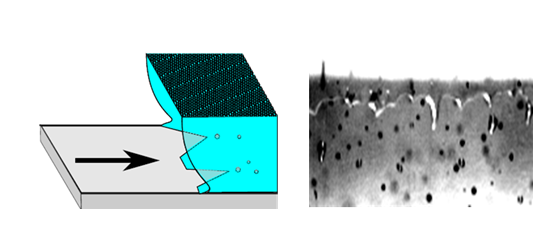
Dynamic Wetting
Dynamic wetting is crucial to processes where liquid displaces another fluid along a solid surface, such as the deposition of a liquid coating onto a moving substrate or the displacement of oil in rock pores. Our efforts are aimed at improving fundamental understanding of dynamic wetting, and harnessing that understanding to address materials-processing-related issues such as the transfer of liquid between two separating surfaces and the entrainment of air in high-speed coating processes.
Interfacial Instabilities
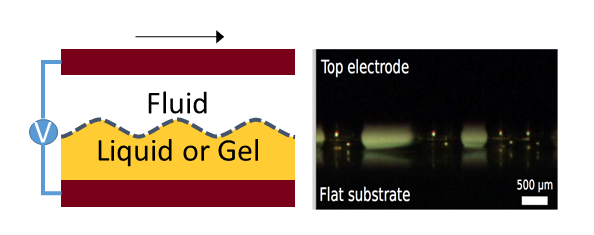
Instabilities at interfaces are usually undesirable in materials processing operations, but can sometimes be exploited for scientific and technological purposes (e.g., creating a topographically patterned surface). These instabilities can be driven by a variety of sources, including hydrodynamic, electrostatic, and intermolecular forces. We are interested in characterizing when and how interfacial instabilities occur, and in developing ways to control them.
Interfacial Flows of Suspensions
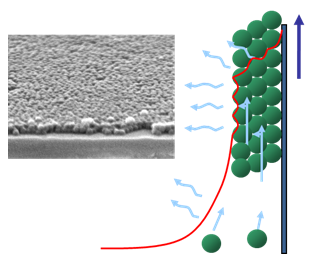
The successful large-scale manufacture of emerging products in the energy and electronics industries requires that particulate suspensions be coated and printed at high speeds with minimal defects. By combining ideas from colloidal rheology and interfacial fluid mechanics, we are examining a number of model problems in this area.
Polymer Dynamics Near Surfaces
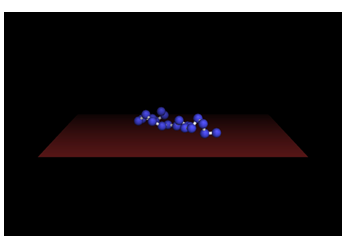
The behavior of polymers near surfaces plays a key role in a variety of applications including biosensors, suspension rheology, and the development of novel nanostructured materials. In many cases, the surface may be patterned chemically and/or topographically, and fluid flows and electric fields may be present. We are applying Brownian dynamics simulations to study how fluid flow, electric fields, and surface patterning can be designed to manipulate the behavior of macromolecules near surfaces. Various molecular theories are leveraged to guide the simulations and to understand the results.
Contributions:
Research topics that Prof. Kumar with his students and collaborators have made significant contributions to include:
-Capillary flow in microchannels
-Dynamic wetting failure and air entrainment in coating flows
-Liquid transfer in printing processes
-Influence of surface roughness, colloidal suspensions, and substrate permeability on spreading and evaporation of droplets and thin films
-Coating of discrete objects
-Nonmodal amplification of disturbances in channel flows of viscoelastic fluids
-Influence of hydrodynamic interactions during polymer adsorption in flowing fluids
-Instabilities of liquid films driven by electric fields and van der Waals forces
-Melt blowing of polymer fibers
-Flow instabilities near deformable elastic solids
-Faraday instability in viscoelastic and surfactant-covered liquids
-Instabilities in viscoelastic free shear layers